
We have plenty of ways to describe the feeling of being disconnected from our own energy and flow. We tell each other to “touch grass”, “stop and smell the roses” and “come up for air”.
When we want to feel more grounded and connected again, nature often seems to be the answer. And research lends support for these expressions: even short breaks in nature can help reduce stress and give us a fresh perspective on life, purpose and meaning.
But what does the research tell us about how nature affects our wellbeing, attention and creativity? In this newsletter, we explore the evidence behind these benefits, look at what influences the effectiveness of nature-based interventions and share insights from a nature-creativity intervention that Beam piloted at an academic writing retreat in October.
Spotlight
| A recent analysis examined research on nature-based activities, including gardening, outdoor exercise and viewing natural scenery. Combining 116 systematic reviews, over 3,800 studies and more than 10-million participants (that’s approximately the whole population of Portugal!), it found that contact with nature was associated with reduced anxiety and depressive symptoms, as well as increased positive feelings, particularly relaxation. |
 |
Going for a long walk or spending time outdoors can act as a reset. But it’s possible that nature can do more than just boost your mood; it can also boost your creativity. In the same vein, people use the outdoors to gain a fresh perspective or even find solutions to problems.
A 2018 paper explores two possible explanations for why this might occur. The first is soft fascination, where nature gently captures our attention, allowing our ability to focus to recover. The second is mind wandering, which allows our thoughts to drift and form unexpected connections between ideas, helping us find new solutions.
While spending time in nature can feel instinctive and effortless, being outdoors doesn’t always guarantee results. How we interact with nature matters, with some approaches appearing to work better than others.
Showcase
A 2025 meta-analysis introduces eight factors influencing the effectiveness of nature-based interventions.

The analysis highlighted the challenges of evaluating nature-based interventions, given the wide variation in their design, participants and settings, as well as the many factors that influence their effectiveness.
Innovation Update
At Beam, we wanted to put these ideas to the test and explore how they might work in practice in supporting researchers with creativity and career resilience. In October, we piloted a nature-creativity intervention at an academic writing retreat, a collaboration with Alive Eco-Journeys (AEJ) and facilitated by Penni Cox. It explored how time in nature could support creativity and academic work.
Participants came to the experience with different expectations, but many left with a renewed sense of calm, possibility and connection.
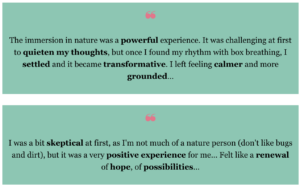
AEJ left participants with four recommendations for bringing a little more calm and creativity into their daily lives.
 |
Take a short daily pause: Small, incremental moments of connection have far-reaching effects, and short pauses can have a positive impact on your work. |
 |
Stay connected as a group: Small check-ins can help make nature connection a shared practice. |
 |
Make room for soft fascination: Between writing blocks, spend a few minutes watching leaves move, observing insects or looking at clouds to give your attention a chance to recover. |
 |
Build nature into your programme: Include a short nature intervention during high-pressure periods to revitalise your mind. |

Please contact us if you have something to share.
Links we love
- Alive Eco-Journeys is where mental health and nature play. The company curates nature-based experiences that help individuals, families and teams reconnect with themselves, with the natural world and with each other. Grounded in eco-psychology and over 20 years of working with groups and teams, every Eco-Journey is shaped around the people in it, whether that’s a 90-minute Silent Stroll where devices are packed away while walking slowly and quietly or a tailored session for a work team, in person or remote, that finishes with a report to help you integrate your learnings. Find out more at www.aliveecojourneys.com.
- Sometimes, we don’t have the luxury of immersing ourselves in nature. When deadlines are looming and time is short, we can bring a little of the natural world into the office instead. It’s not quite the same as getting outdoors, but sometimes it’s the next best thing. The BBC Sound Effects archive offers a collection of nature recordings, including everything from birds chirping to rain and water flowing.

